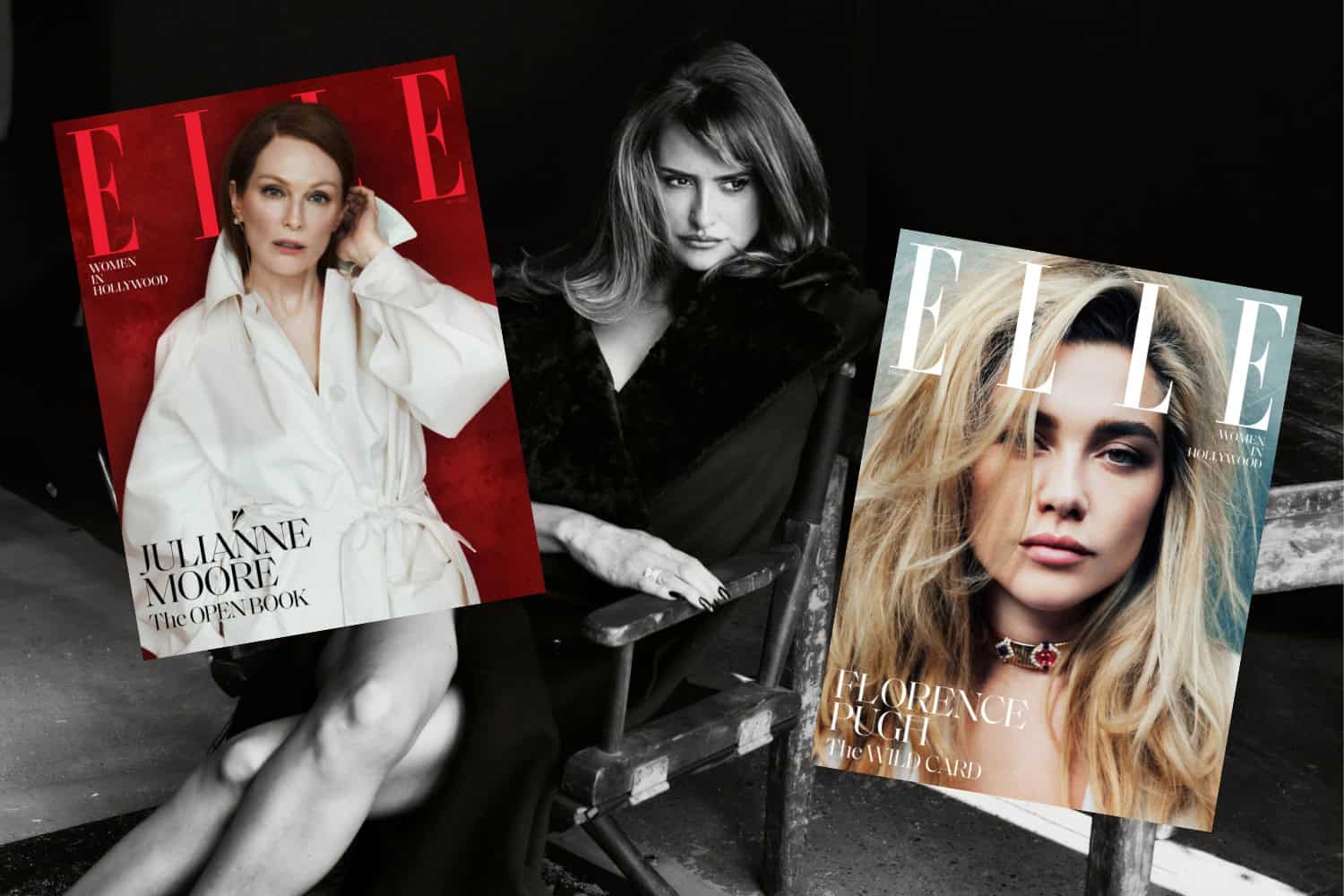
On Tuesday, Nov 10, ELLE released the 2026 edition of their annual “Women in Hollywood” portfolio starring some of the acting industry’s most established and celebrated leading ladies — Florence Pugh, Penélope Cruz, Julianne Moore, Rosalind Eleazar, Carrie Coon, Samantha Morton, and Elizabeth Debicki — and one very buzzy newcomer, Obsession star Inde Navarrette.
Below, check out photos of all the stars as well as some of our favorite quotes from their interviews. And, of course be sure to pick upo your copy of the December 2026 / January 2027 Women in Hollywood Issue when it hits newsstands on December 1.
Florence Pugh

Florence Pugh (Norman Jean Roy for ELLE)
On being raised to speak her mind and stand up for injustices: “My dad has always hated bullies, and he’s always told me that if you ever see anything, you have to do the right thing. Otherwise you are just the same as them,” she says. “And I think that’s where that instinct of ‘I must speak out on this injustice’ comes from. It’s always important to stand up for people who don’t have the voice that I have. I have the ability, and I have to use it. I don’t know who I would be if I didn’t.”

Florence Pugh (Norman Jean Roy for ELLE)
On why she felt compelled to post about the accusations at Cornell: “Because I’m a woman who cares about women. I care about women I know, and I care about women I don’t know. And if we allow for stories like that to become in any way normal, then we are allowing ourselves to continue toward that destiny of abuse and rape being accepted as a norm,” she says. “Rape can never ever be a conversation that we move on from. It has to be something that we look at, face-on, and we demand justice, accountability, and for the rapist to see what they have done to someone’s life. Because if we don’t, we’re accepting it. And I don’t ever, ever, ever want to live in a world where we move on from it easily.”

Florence Pugh (Norman Jean Roy for ELLE)
How playing Cathy in Zoe Kazan’s East of Eden adaptation is exactly the type of woman Pugh loves to take on: “I don’t know how to describe it other than I play characters that ask a lot of audience members,” Pugh says. “I think there’s something that excites, and also troubles, people about the way that I find humanity in even some of the most evil characters. I think it fascinates people.”

Florence Pugh (Norman Jean Roy for ELLE)
On scrutiny in Hollywood: “There’s so much scrutiny of how we look, how we dress, and how we age. And then when we do those things, they’re like, “Oh my God, she looks like this, or she’s done too much of that, or she’s gained weight, or she’s lost too much weight.” You can never get any footing right. I feel like the best work that I’ve ever done is when I truly feel ugly. When I’ve got s**t makeup on and I’m either sick or ugly or having a hangover or a breakdown. I love that type of makeup because it allows me to be free.”

Florence Pugh (Norman Jean Roy for ELLE)
On being nominated for an Oscar: “The moment I got that nomination, it’s like the pressure just vanished—there was nothing breathing down my neck anymore. I felt the energy of how people wanted to work with me change. It was not only just a pat on the back that I could feel, but it was a pat on the back that I felt like everybody could see. But it also made me even harder on myself to get another one. It’s like, I know that I’ve achieved this before. I can achieve this again.”
Penélope Cruz

Penélope Cruz (Norman Jean Roy for ELLE)
On directing her first film, a documentary with a subject matter she isn’t yet ready to share, but expects to finish next year: “It’s sad that it still has to be a conversation,” she says. But at the same time, “we cannot ignore it and look the other way and pretend like there is any kind of equality in those terms.”

Penélope Cruz (Norman Jean Roy for ELLE)
On working with her husband, Javier Bardem on their latest collaboration, Bunker: “We don’t want to do it too much, but once in a while it’s great,” she says of working together. “It’s just not something we want to do all the time. It would be too risky. We have 33 years of friendship and then a lot of years of relationship as a couple. Of course, a lot of things are the same, but you both have changed and grown together,” she says. “And that’s going to be present in the work… you can see and understand each other with one look.”

Penélope Cruz (Norman Jean Roy for ELLE)
On the films that made her feel seen: “I feel it was through a lot of characters that I discovered in all the films that I watched, but especially all the films from [Pedro] Almodóvar. I would watch his films and feel like, See, I’m not strange. I’m not strange because I say I want to act. I’m not strange because in class I’m thinking about a million things…daydreaming and fantasizing. He made me feel normal. He made me feel that it was okay to be like that, but my parents did as well. They never judged me in those terms, because I think they’re artists in their hearts.”

Penélope Cruz (Norman Jean Roy for ELLE)
On a woman in Hollywood who helped her out: “Salma [Hayek Pinault], because she’s one of my best friends. And she basically took me to her house when I arrived in L.A. for my first movie. I was going to a hotel alone. And she said, “I’m going to pick you up.” She didn’t let me go to the hotel. She took me to her house. It’s like family: Even if we don’t see each other all the time, we’re really, really close.”

Penélope Cruz (Norman Jean Roy for ELLE)
On singing Sade to Seth Rogen in The Invite: “I had this vision: I just saw the scene in my head of me singing Sade to Seth. I arrived to the set and said, “Olivia, I think at that moment before anything happens, the way that we get to connect with each other is with me singing Sade to him, and she would know the lyrics and everything.” And she said, “Oh, let’s listen to it together.” And then I played her the song, which she already knew, and she completely understood what I was talking about, and we did it. And we just felt that it was working because it was really funny and absurd. We all brought things like that.”
Julianne Moore

Julianne Moore (Norman Jean Roy for ELLE)
On why she’s interested in playing women who find themselves trapped by circumstances: “I’m moved by people and the choices that they make, how they live and who they love and how we’re affected by the society that we live in,” she says. “Particularly for women: What world are you living in? What choices are offered to you? As someone who was born in the 20th century and saw what was offered to the women around me, what changed and what didn’t—I saw what opportunities were afforded to my great-grandmothers, my grandmother, my mother, and then me. My mother was someone whose parents didn’t send her to college, because they didn’t send girls to college. They sent her brother to college. So she went later, after she had kids.”

Julianne Moore (Norman Jean Roy for ELLE)
On mastering Mona’s singing voice for The Debut: “The unsteadiness was easy for me, because I’m not a natural singer. I haven’t been trained. So that was easy and kind of fun in a way—because it’s not like she can’t carry a tune; she sang in church—but she doesn’t have any power, and she has no emotion behind it. I worked with a wonderful vocal coach and with all of our [supporting cast]; they’re all from musical theater. But the day that I had to sing that song [Mona’s big solo moment] live in the room was very early on in our shoot. A lot of people were there—they were in the other room around the monitor, and all of those people I’m singing to are real [Broadway] singers. There was a lot of support for me, and I think a lot of concern. I was scared.”

Julianne Moore (Norman Jean Roy for ELLE)
On aging: “There’s not a right way or a wrong way to age. So given that we have a limited time on earth, let’s not put that pressure on ourselves that we’re doing it wrong. I read that Helen Mirren said something like, “There’s this idea that somehow the things that happen to you when you’re older will feel less interesting to you because you’re old.” And she was like, “They don’t. They feel just as interesting.” And I think as a young person, you don’t always know that, because we’re always so focused on ourselves, we just assume that when we’re older, nothing will matter. But it does.”
Rosalind Eleazar

Rosalind Eleazar (Norman Jean Roy for ELLE)
On how Eleazar recognized immediately the script for Misty Green was unlike anything she’d read before: “Chris [Rock] really wrote her fearlessly, and he wasn’t frightened to show the uglier side,” she says. “He and I were keen not to sanitize her and make her soft and palatable. I was pretty bowled over with what he wrote and how unapologetically he wrote it. The character just came off the page to me,” Eleazar adds.

Rosalind Eleazar (Norman Jean Roy for ELLE)
On how Chris Rocke trusted her and gave her leeway to shape the part in Misty Green: “He has this expression, ‘My movie, your character,’” Eleazar says. “He allowed me to really explore Misty, because she’s unique and wild and untethered. In order for me to do that, I needed to also feel untethered and without boundaries.”

Rosalind Eleazar (Norman Jean Roy for ELLE)
The rapturous response to Eleazar’s performance in Misty Green will undoubtedly transform her career, but she doesn’t yet know what impact it will have on the roles she is offered. “I do hope that it will give me more choice,” she says. “But our job is not like a lawyer, where you start as a junior associate, and you can see your trajectory to partner. It’s just not like that. It depends on what’s around. It depends on where you are in your career. It depends on your age.”

Rosalind Eleazar (Norman Jean Roy for ELLE)
On receiving a TIFF Tribute Performer Award alongside A-list stars the day after Misty Green premiered: “I can’t even put into words how special a moment it was,” she says of the premiere. “Then, the next day, to be recognized for my work in Misty, with Helen Mirren and Penélope Cruz, was the icing on the cake. Seeing my mom’s face when I was making the speech was a reminder of the things that are important to you.”
Carrie Coon

Carrie Coon (Norman Jean Roy for ELLE)
On the pressure to be “ageless”: “Of course, women should do what they want to do to feel their best, to not be depressed. However, it is worth questioning what we have internalized and where that choice is coming from. My experience, as I’ve watched this augmentation take over my industry—and then everything else, because my industry leads those conversations—I find it so alienating. When I see an actress who’s so far down the road that I do experience their face not moving, I don’t have as much empathy for them in their performance. I don’t have the mirror neurons… and my baseline is, ‘Oh, I see your fear. You’re afraid to die, and you’re afraid to get old.’ And for me, every choice you make is coming out of that fear. I personally am not interested in living my life from that place. I’m not interested in making artistic choices from that place, because I would rather come to terms with the fact of my death, which will happen, because I don’t want to be unprepared.”

Carrie Coon (Norman Jean Roy for ELLE)
On the double standard facing women filmmakers in Hollywood: “We know that it’s hard for women to get a first feature made. And even when their first feature is wildly successful, getting a second one made is nearly impossible. They don’t get offered the big tentpole movies. And if they screw one of those up, heaven forfend, they’ll never get a second chance to make anything. It’s such a punishing system. It’s not a meritocracy. Women never get a blank check. We have to justify every choice we make, and then we have to explain every mistake. The double standard is so unfair.”
“Something like The Liberation is so exciting for me, because I don’t have access to leading roles in film. I have to fight for every [role]. Which is fine; I’m a fighter. But it reflects the reality of how little work there is to go around.”

Carrie Coon (Norman Jean Roy for ELLE)
On her friendships with other actresses: “I came to female friendship late. I was a tomboy and I had brothers, and I’m sure I wasn’t a great friend in my early years. And, oh my gosh, all I want is female friendship. I want to make those phone calls when I need advice. I want to go on long walks with women. And if my husband dies, he keeps joking, ‘Oh, your second husband’s going to love this couch.’ I’m like, ‘No way I’m doing this again.’ Not because I don’t love him, not because he’s not a great feminist, but because I’m ready for the crone years. I just want to get a bunch of women together. We’re going to cook. We’re going to talk about menopause. We’re going to have a book club. We’re going to dance naked in the moonlight because we don’t care. That’s what I want. And I didn’t know I needed it.”
Samantha Morton

Samantha Morton (Norman Jean Roy for ELLE)
On landing the role of Circe in Christopher Nolan’s The Odyssey: Nolan told her he had her in mind for Circe from the start. Morton says she felt prepared to give the role everything she had, like an Olympian who had been training for years and had been given the opportunity to go for gold. “He’s a master at his craft, and there are not many masters in the world right now. As an older woman, I get better and better all the time at what I do, but the roles get fewer and farther between,” she says. “I was ready for Chris. I’m like, ‘I’m here. I’m ready. I’m waiting to do my best for you.’”

Samantha Morton (Norman Jean Roy for ELLE)
On what still needs to change for women in Hollywood: “Parity for female directors. I’m on a show at the moment, and there are no female directors: The female directors that were potentially approached were busy, and then ones that I recommended for my work were not cleared because they’re not experienced enough. But we need to get the experience. It’s kind of a Catch-22.”

Samantha Morton (Norman Jean Roy for ELLE)
On being a woman in Hollywood: “Being a female actress is really complicated—from having your period on set, to the bathrooms always being quite far away, to if you do have gynecological issues, which a lot of women have, whether it’s endometriosis, adenomyosis, or fibroids. We have to do that working 16- and 17-hour days and six-day weeks. And we have children, and our breasts get bigger and smaller, and our bodies go in and out. It is incredibly tricky to be a female performer. The world is brutal to women, certainly now in regard to social media, the globalization of our image, cruelty, and the way that women are scrutinized for everything they do: how they are in interviews, how they are on the red carpet, what they look like, how big or how small they are, their relationships, whether those relationships last a long time or don’t.”
Elizabeth Debicki

Elizabeth Debicki (Norman Jean Roy for ELLE)
On finding her next chapter following The Crown: Her most famous role, a transcendent performance as Princess Diana in seasons 5 and 6 of The Crown, won her a Golden Globe and tremendous praise. But when the show ended in 2023, it wasn’t clear what would come next. “I was really looking for a while, after I did The Crown, for something I wanted to do,” Debicki says. “It took a little while for me to find those jobs. When you play a real-life person, you can come out really synonymous with a piece of work, and people think of you solely in relation to that piece of work, which is totally unsustainable. You do a bit of reeling after you do a job.”

Elizabeth Debicki (Norman Jean Roy for ELLE)
On what she wishes she knew starting out: “The thing that’s taken me the longest to learn is what to do with my real life. When acting is the thing that you obsess over, that interests you most, that you’re the most driven to continue to do, it’s a bit of a compulsion, and your real life can get waylaid. It took me a while to learn, in my late 20s and into my 30s, that it helps you with your work to have a life that you like and that you want to live.”

Elizabeth Debicki (Norman Jean Roy for ELLE)
On her craziest “only in Hollywood” story: “[When I auditioned for The Great Gatsby] I was 20 and I’d never been to America. I flew in; I went to the Standard hotel on Sunset Boulevard. I had the audition the next day. Then there was a knock on the door, and I looked through the peephole. There was Baz Luhrmann’s magnified fish-eyed eyeball. I was standing in my bare feet in the Standard hotel thinking, ‘That’s Baz Luhrmann.’ Then I went over to the Chateau Marmont, and I auditioned with Tobey Maguire. It was so Hollywood. I was 20 and I was like, ‘This is ridiculous. I’ll probably never come back here again.’ So I went down to the restaurant and ordered a glass of champagne and a grilled cheese sandwich. Then I looked over my shoulder, and up on the balcony was Leo [DiCaprio]. Leo was peeping over and Baz was saying to him, ‘That’s her.’ I remember thinking, ‘Fifty-fifty—I’ve either got the job or I don’t.’”
Inde Navarrette

Inde Navarrette (Norman Jean Roy for ELLE)
On her Hollywood story: “Trusting yourself might be the key to making your dreams come true. I know for a fact that my life completely changed when I started doing the things I had been procrastinating about. Up until I was 23, I was a really big people-pleaser. I wanted to make friends, and it was very important to me how I was being seen and acknowledged. When I turned 24, I started looking at life differently, because I didn’t feel good. Something needed to change. So when I went to work on Obsession, I told myself, “I’m not coming here to make friends.” It was the first set I ever went on where I solely walked in as an actor and left as an actor. After production ended, friendships naturally blossomed with the people I worked with, and they’ve turned into some of the best friendships I’ve ever had.”

Inde Navarrette (Norman Jean Roy for ELLE)
On her breakout in Obsession: “When I go outside now, people yell ‘Nikki,’” she says. “It’s almost like they’re yelling ‘Inde.’ It doesn’t help that both names end in a similar sound.”
“It’s a dream for Nikki to feel understood,” she says. “The fact that she is makes me happier than I could ever have imagined.”
Ironically, as a child, she was “super scared” of horror movies. She and her siblings loved watching them, but Navarrette describes herself as an empathetic kid who internalized everything happening on the screen as if it were happening to her. To this day, she says, if someone puts a scary movie on, “I freak the f**k out.”

Inde Navarrette (Norman Jean Roy for ELLE)
On landing a huge new role: as Rogue in the upcoming X-Men reboot from Marvel Studios: “Her mind must be fascinating, because she is starved of human touch,” she says of her character. “I would personally die if I couldn’t hug my friends and family.”

Inde Navarrette (Norman Jean Roy for ELLE)
