
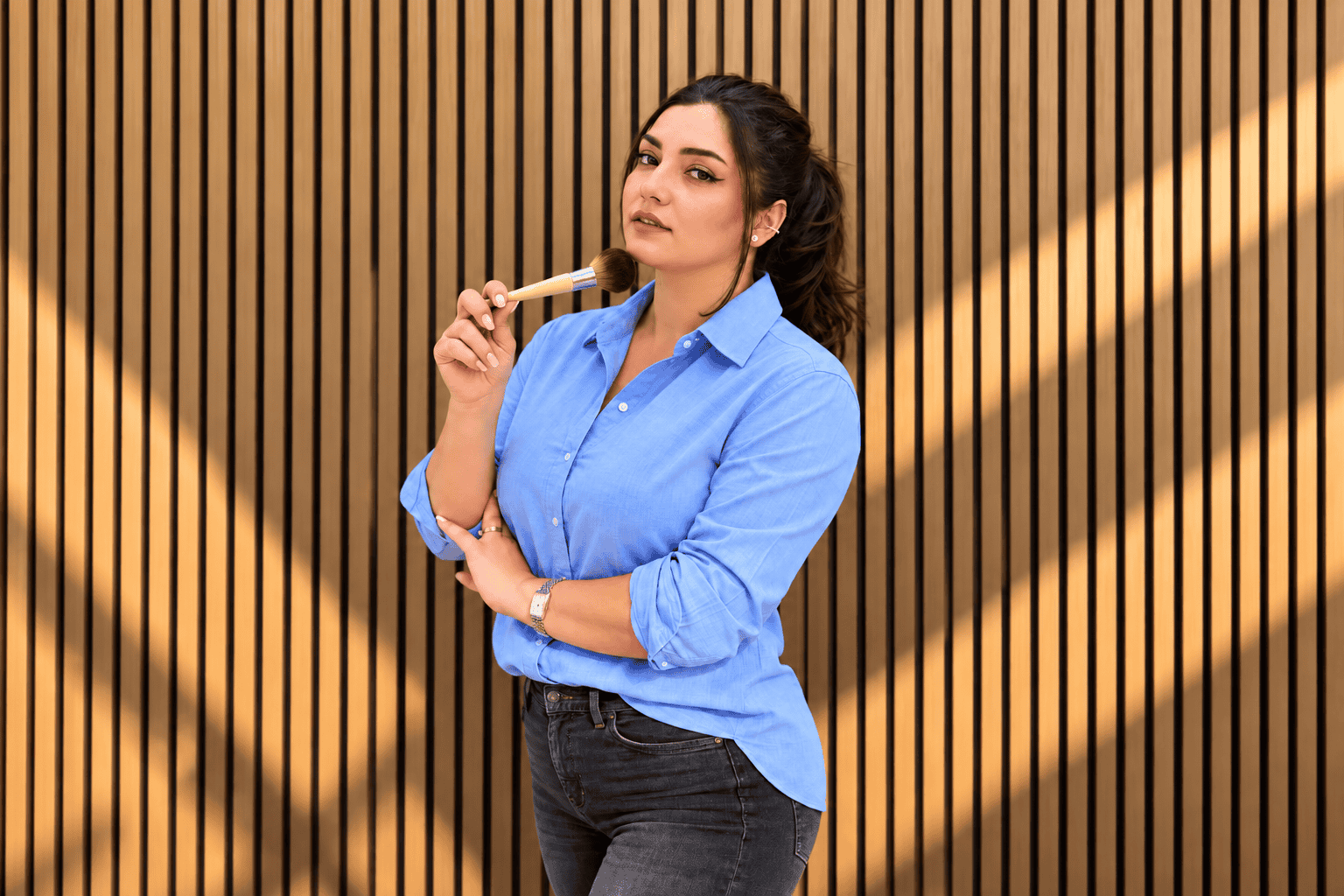
As autumn begins, a new season of international beauty championships gets underway, attracting particular attention from the professional community. Each competition brings new names, works, and ideas that subsequently shape trends across the industry. Yet the most interesting part often remains behind the scenes: how judging is conducted, what can cost participants points, and which details can influence the final score.
Leading makeup artist Anna Ovasafian knows the competition industry from both sides. She herself won a gold medal at the international online TB Champions competition, organized by TE’ORA Beauty Corp, and also serves as a judge and is a member of the prestigious Association of Beauty Professionals. Her experience offers a perspective on professional competitions not only through the eyes of an artist creating a look, but also from the judges’ table.
What really happens during beauty battles, which mistakes go unnoticed by the audience, and why is beautiful makeup no longer enough to win?
– You made a major impression in the United States after winning at the prestigious TB Champions championship organized by TE’ORA in February this year. It created quite a buzz, as this international competition is known for its rigorous selection process. Its judging panel includes Hollywood experts and celebrity artists who work at Fashion Weeks and the Oscars, while top makeup artists from dozens of countries compete for the titles. How did you manage to take home two awards — the highest Gold in the Creative Makeup category and Bronze in Evening Makeup — in such a competitive field?
The key is the “blind” judging system. The judges see the entries by number and have no idea who created them. Everything is evaluated online from photographs where every pore and every hair is visible. Retouching is not allowed.
What helped me win? I think my experience in Poland and Ukraine played a major role. I worked as a leading makeup artist for many years, regularly preparing celebrities and VIP clients for major events. Over the years, I developed concepts for all kinds of creative makeup looks for photoshoots.
I have a deep understanding of how different cosmetic brands perform on camera, under flash photography, and across different skin types. I believe that strong European training and experience had a significant influence on my results.
– We tend to think of championships as something that happens on a stage or runway. How do online competitions actually work? What makes them fundamentally different from traditional in-person competitions?
The difference is enormous, and sometimes online competitions can actually be more challenging.
Here’s why: when judges look at a model in person, they cannot zoom in on the skin and examine every detail. They see the overall picture. And if the model is charismatic, that can certainly enhance the presentation.
Online, everything works differently. Participants upload their materials and photographs, and the judge enters the system and examines each submission carefully. Everything is right there in front of them. You cannot hide behind a beautiful model or presentation. The scores are then assigned based purely on technique.
-But with this format, there must be a huge temptation to digitally enhance the makeup in something like Photoshop. How do judges catch competitors who cheat?
Exactly. That’s why major online championships such as TB Champions require not only photographs but also additional materials, including detailed macro footage of the makeup process.
In video, there is nowhere to hide real skin texture. As soon as an artist tries to manipulate the image or add filters, it starts to look artificial, and an experienced professional can spot it. The participant can then be disqualified. There are also specialized software tools that can help detect manipulation.

(Courtesy)
-What about the backstage reality of offline competitions? What unexpected situations have you encountered in Europe?
At my first professional competitions in Eastern Europe, there were many artists working in the same room, while organizers were constantly pushing everyone to move faster.
You also depend on so many little things. Someone might accidentally bump your hand while you’re working, or the model might become overwhelmed and start crying — that actually happened to me!
And there have been plenty of real emergencies, too. I remember flying to another city for the final stage of a competition, and the airline lost my luggage containing all of my makeup products.
I still don’t know how it happened. I had to run to the nearest store and urgently buy whatever supplies I could find. They didn’t have the color I needed, so I ended up buying a cheap little palette from the children’s section. It had glitter in it — I remember it very clearly.
But you need that kind of experience. Without live competitions, you simply don’t develop the professional resilience that this industry requires.
-And what are relationships between competitors like backstage?
It varies. But of course, there is a competitive atmosphere in the air — it would be silly to deny that. Everyone comes there to win.
I’ve never had any conflicts myself. And I’ve never witnessed the kind of dramatic situations you see in movies, where someone steals brushes or deliberately ruins another artist’s makeup kit, at major championships.
-You also serve as an official judge at international beauty championships. For example, you were part of the judging panel at the Beauty Championship by Te’ora Beauty. How much does your perspective on the competition change when you are evaluating your peers rather than competing yourself?
Completely. When you are a competitor, you are focused entirely on your model. When you are a judge, you see the whole picture and understand how transparent the scoring system really is.
For me, judging is a huge responsibility toward the beauty industry. My role is to help move the industry forward, recognize new trends, and guide artists.
And, by the way, my experience as a judge has been incredibly valuable in both my teaching and my professional work.
– And speaking of education: you have developed and lead your own Make Up Artist program and serve as a mentor and teacher to other makeup artists. What is your approach to teaching, and what do you believe it is important to teach artists beyond makeup techniques themselves?
The most common mistake beginner makeup artists make is learning to copy other people’s work. They watch a tutorial, repeat the technique, and it looks beautiful a couple of times. But clients are different—everyone has a different face, and most of the time, they look nothing like the models in tutorials. They have their own skin and their own individual features. That’s where the real work begins, and that’s what shows whether you are truly a professional or not.
I don’t want to graduate artists who only know how to copy. In my program, we focus a lot on teaching students to recognize individuality and make decisions independently: which technique to choose, which texture to use, and what to change if something doesn’t work.
-The beauty world is regularly shaken by controversies over alleged judging bias. There have even been high-profile cases at competitions such as Miss Universe, where organizers and judges have been accused of manipulating scores and promoting certain contestants. What happens behind the scenes of judging at major professional makeup championships? Is it actually possible to judge completely objectively when judges have radically different opinions?
Yes, scandals can damage the reputation of the entire beauty industry. But at reputable championships, scoring systems are designed to minimize the human factor as much as possible.
Of course, disagreements happen, and sometimes they can be quite intense because judges come from different schools and have different professional backgrounds. But every score in the judging sheet has to be justified.
The exact criteria vary from competition to competition, but the fundamentals often include cleanliness, symmetry, and complexity. You cannot simply give someone a lower or higher score because you personally like or dislike the artist or their work.
-Is it true that judges can deduct points during the competition itself, for example because a makeup artist’s workstation is messy?
Absolutely! Backstage work culture is just as important as the makeup itself. Dirty brushes, a messy workstation, or the absence of disinfectant can all become reasons for deductions.
There are many details that only professionals really understand. That’s why creating a beautiful makeup look is not enough. Judges observe the entire process from A to Z.
– And finally, I’d like to touch on one of the most challenging aspects of judging creative categories. Where do you draw the line between a truly bold artistic decision and work in which shortcomings are being presented as artistic intent? As a judge, what criteria do you use to tell the difference?
True avant-garde work is always built on an ironclad understanding of the fundamentals. If I see that the shape has fallen apart or the eyeshadow has been blended messily, no explanation about “this is how I see it” will save the work. Judges see everything, so you shouldn’t underestimate them.
Creativity is the ability to break the rules. But you can only break the rules beautifully when you know them 100 percent.
Presented by DN NEWS DESK
